From Card to Story: How an Islamic Card Game Brings Mythology to Your Table
An Islamic card game is a tabletop game built around the cosmology, characters and moral world of a Muslim-inspired fantasy universe.
An Islamic card game is a tabletop game built around the cosmology, characters and moral world of a Muslim-inspired fantasy universe. Khayaal Cards brings the lore of Ikleel to a playable 54-card deck for two to four players, with three game modes still being developed and refined through active playtesting.
Welcome, seeker. If you’re wondering whether this means a lecture dressed up as a game, the answer is no. Khayaal Cards is designed for the table: a deck to play, explore and talk about, set in the wider Khaverse. Its spiritual ideas inform a fictional world and its adventures; the game is not religious instruction.
What Khayaal Cards actually is: the honest version
Khayaal Cards is a 54-card deck for two to four players. The deck is playable now, while its three game modes, Truth and Falsehood, Conduit Clash and Pledge of Allegiance, are still in development. They are being refined, and playtesting is actively shaping them. None should be treated as a finished or final ruleset.
That distinction matters if you’re curious about how the game plays. The honest answer is that there is a playable deck, but the modes are still evolving. Rather than pretend to offer a final rulebook, we can tell you what the cards draw from: the characters, abilities and moral tensions of Ikleel.
| Khayaal Cards at a glance | Details |
|---|---|
| Cards | 54-card deck |
| Players | 2–4 |
| Play time | Not specified |
| Modes | Truth and Falsehood, Conduit Clash, Pledge of Allegiance; all in development |
| Art | Human-drawn throughout; heart-centred, hand-made illustration |
| Status | Playable product available now; modes being refined through active playtesting |
You can find more about the deck and its developing modes on the Khayaal Cards page.
Where the cards come from: Ikleel, Kha and the Isthmus
The deck’s world is Ikleel, a planet of cities, empires and hidden histories. At its heart is Kha, a divine energy flowing from the Source via the Isthmus. Those who wield Kha are known as Conduits.
The lore distinguishes between Nurani Conduits, noble in their service to the Creator, and Dhulmi Conduits, who are corrupt. Their conflict gives the setting more to consider than who has the strongest power. It asks what power is for, how it is used, and what happens when its purpose is distorted.
That makes the Conduit system natural material for a card game. Energy, its source, the people able to wield it, and the difference between noble and corrupt use all offer meaningful tensions to build around. The lore names abilities including Nourishers, Threaders, Calmers, Clarifiers, Hefters, Imbuers and Revealers. These give the world different ways of imagining what Kha can do, without requiring players to know every detail before sitting down.
The important point is that these abilities and alignments are part of the fictional setting. They are not claims about real-world spiritual practice, nor a guide to religious belief. For more on the setting and its terms, explore the lore of Ikleel.
Three modes in development
The names of the modes hint at the ideas the designers are exploring. The details are still being shaped by playtesting, so treat these as glimpses of direction, not descriptions of completed rules.
Truth and Falsehood
The name points towards questions of truth and deception, themes that sit naturally in a world where hidden motives and competing accounts of events matter. The mode remains in development; its final play and rules are not established here.
Conduit Clash
Here, the name brings the Conduits and their opposing uses of Kha to mind. Nurani and Dhulmi make for a world of contrasting purposes and allegiances. How that lore becomes a complete mode is still being worked through in playtesting.
Pledge of Allegiance
The title suggests loyalty and commitment, questions that recur across Ikleel’s stories. Whom do you stand with, and what does that choice mean? The mode is being developed and refined, not presented as final.
Across all three, playtesting is not an afterthought. It is helping shape the modes as they develop.
How playtesting shapes the modes
A card mode is not finished when the deck is printed. It is finished when enough people have sat around enough tables, misunderstood the same rule, found the same loophole, and told you about it. Playtesting is that conversation in slow motion.
For Khayaal Cards, that process is live now. Players meet the deck, try what is there, and their responses feed back into how the modes are refined. Sometimes that means a clearer rule. Sometimes it means a mode discovers the shape it was always reaching for. Either way, the deck is not handed down as a sealed object. It is being made in the open, in the company of the people who play it.
Why faith-inspired tabletop play appeals
A fantasy game can be meaningful without turning into a lesson. For many players, part of the pleasure is entering a world where questions of purpose, responsibility and the use of power are taken seriously, then seeing those questions placed inside an adventure.
That is the space Khayaal explores. Its stories draw inspiration from Islamic cosmology and the metaphysical idea of khayaal, or spiritual imagination, alongside the rich legacy of diverse Muslim cultures. The result is a fictional world with its own characters, conflicts and history, not a retelling that asks players to accept a religious ruling.
There are no fatwas or doctrinal claims in the invitation to play. Muslim readers and players may recognise some of the inspiration; non-Muslim players are welcome to meet the world on its own terms. Curiosity about lore, character and strategy is enough to take a seat.
That matters more than it might seem. A game built on a faith-inspired world could easily become a quiz about who belongs. Khayaal Cards does not ask that. It asks whether you can hold your nerve when the stakes rise, whether you can read another player's intentions, and whether you want to find out what happens next. The spiritual framing gives those questions weight. It does not decide the winner.
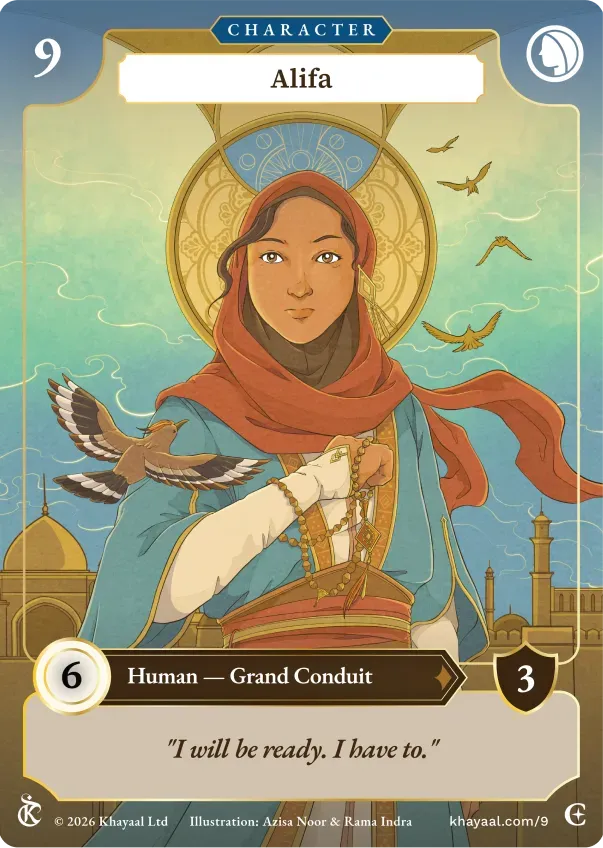
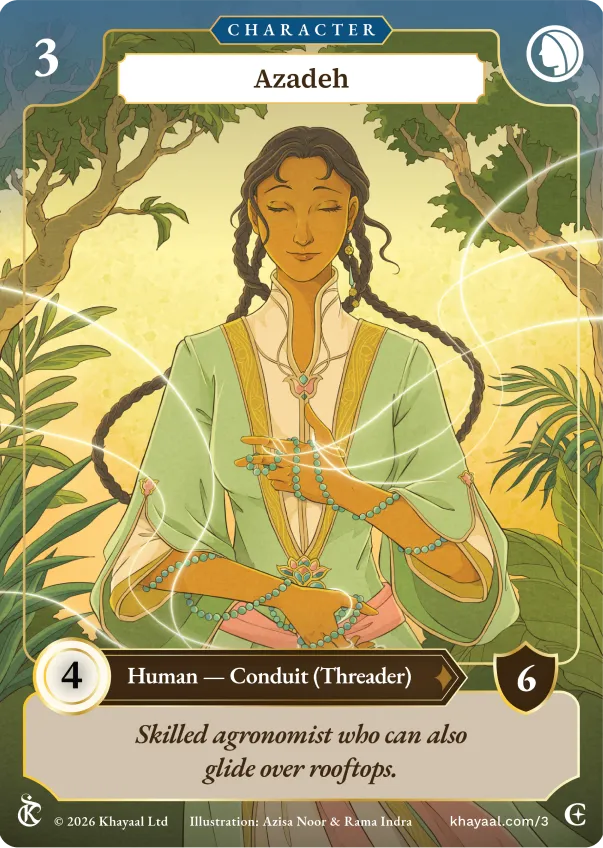
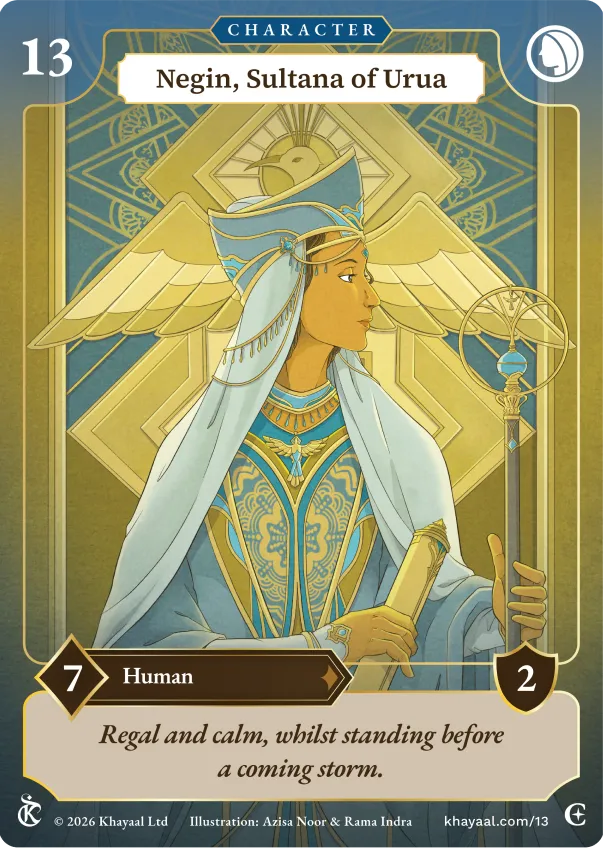
There is also the quieter pleasure of playing something that feels made rather than manufactured. Every face on every card was drawn by a human hand, with attention to costume, bearing and the small details that make a character feel like someone rather than something. You notice it the first time you fan the deck out. It invites a different kind of attention, and attention is what makes a table game memorable.
If you enjoy reading about how cultural and spiritual inspirations can shape fantasy, our reader’s guide to Islamic fantasy books offers a related path through the genre.
From card to story: Scenario Moments and the novels
A card can be more than a portrait or a set of game information. In the Khayaal game and lore booklet, Scenario Moments are prompt-based narrative experiences. They offer a bridge from the cards to imagining a situation, a choice or a story together. They are prompts, not a claim that every draw produces a complete role-playing adventure.
So, is Khayaal Cards an RPG card game? It has a narrative connection through those Scenario Moments, but it is distinct from the full Khayaal tabletop role-playing game. The deck brings players into the lore; the prompts create space to imagine within it.
That lore also unfolds in the novels. Tales of Khayaal: Arön, Book One, is out. Tales of Khayaal: Cin, Book Two, arrives via the crowdfund. Co-creators Rehan Khan, writer and loremaster, and Peter Gould, designer, are building a planned seven-book arc. That is a plan for the wider story, not seven finished books.
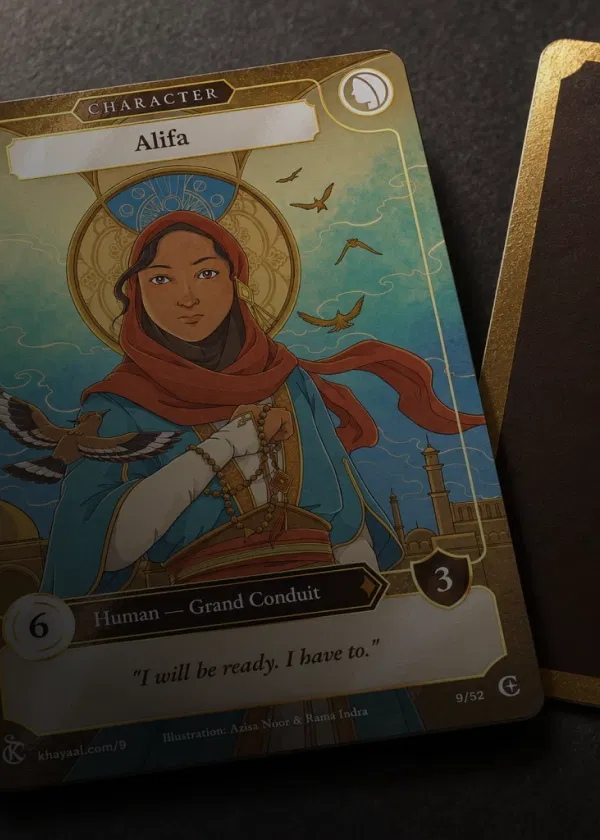
For instance, Alifa, Grand Conduit and central figure in the novels, belongs to the same world that the cards invite you to explore. A card can give you a face and a name; the story asks what that person might risk, choose or protect. To see how a table game fits alongside other home games, read our family board games for game night guide.
What to expect at the table
Expect a playable 54-card deck for two to four people, with hand-drawn art throughout and a world rich in characters and lore. Do not expect the three named modes to be finished: Truth and Falsehood, Conduit Clash and Pledge of Allegiance are all being refined, with active playtesting helping shape them.
That means the straightforward answer to “is it genuinely playable?” is yes, the deck is available as a playable product now. The equally important answer is that the modes are still in development. The game is growing, and its final form is not something we should claim before it is ready.
Frequently asked questions
What is an Islamic card game?
It is a tabletop card game shaped by the cosmology, characters or moral world of a Muslim-inspired setting. Khayaal Cards is a 54-card game set in Ikleel, a fictional planet in the Khaverse.
How many players can play Khayaal Cards?
The deck is for two to four players. A play time has not been specified.
Are the Khayaal Cards game modes finished?
No. Truth and Falsehood, Conduit Clash and Pledge of Allegiance are all in development and being refined through active playtesting.
If you’d like to support the next part of the Khaverse, back the Tales of Khayaal crowdfund before it ends on 30 December 2026. Early supporters get Book Two, exclusive merch and the card game.

Join the Khayaal Circle
We invite you to join a growing community of like-hearted Khayaalis in the next phase of our journey. Sign up for exclusive updates, sneak peeks and join playtesting communities and become part of the community to receive meaningful updates.